Follow the Land: What South Florida’s Six-Year High in Land Sales Tells Us About Where Development Is Heading

South Florida’s land market just posted its strongest numbers since 2019. According to data released this month by the Miami Association of Realtors, wealth migration and sustained population growth drove land sales across the region to a six-year high — with Miami-Dade leading the charge at $2.1 billion in volume, a 62% jump from the prior year, and Palm Beach County topping all counties at $3.9 billion. The largest single land deal in Palm Beach County was the acquisition of a vacant commercial parcel in West Palm Beach for $87 million, or $2,015 per square foot.

Those aren’t just impressive numbers. They’re a map of where South Florida commercial real estate is heading next.

Miami-Dade Is Running Out of Room

The story behind the surge in land activity is, in large part, a story about scarcity. Miami-Dade is geographically boxed in — the Atlantic Ocean to the east, the Everglades to the west. There is no horizontal expansion left. As one industry expert put it plainly: “In Miami-Dade, we’ve run out of land east and west of us. West of us is the Everglades, so for density purposes, we really need to go vertical.”

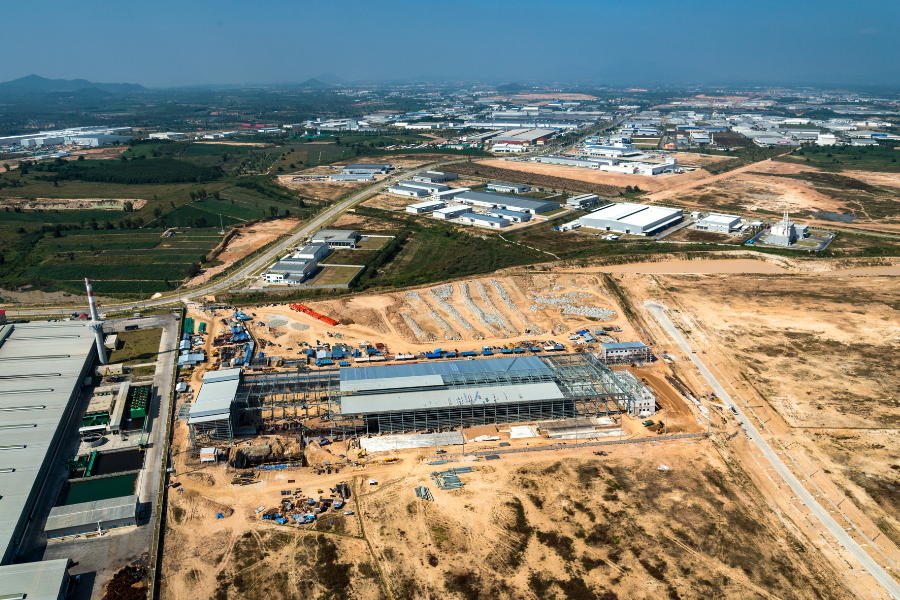
That constraint is showing up directly in the commercial market. Industrial vacancy rates in core Miami-Dade submarkets like Doral and Medley remain among the tightest in the nation — holding around 3–4% — while average asking rents for warehouse space have climbed to $16–$20 per square foot NNN. Developers searching for large-format industrial sites are increasingly filling in man-made lakes and rock pits just to find buildable land. When the workaround for land scarcity involves filling in a lake, you know the market has reached a structural limit.

The result is predictable: capital and developers are moving north.

Broward and Palm Beach Are the Next Frontier

The pressure migrating out of Miami-Dade is landing squarely in Broward and Palm Beach counties — and the land data confirms it. Lennar’s publicly traded land bank paid $50 million for a vacant commercial site in Pompano Beach for a mixed-use residential project. Industrial developers are actively pursuing sites along I-95 and the Turnpike corridors where land is still available and land costs, while rising, haven’t yet hit Miami-Dade levels.

For industrial and logistics specifically, Broward’s positioning is compelling. The county sits between two of the busiest ports in the country — PortMiami and Port Everglades — with direct access to major interstate infrastructure. As e-commerce demand, tourism supply chains, and population-driven consumption continue to grow across the tri-county area, the need for last-mile distribution and warehousing isn’t slowing down. It’s just shifting north.

Palm Beach County, meanwhile, is seeing a different type of land demand — one driven by the corporate and residential migration story we’ve covered in recent months. Commercial land in West Palm Beach is now trading at over $2,000 per square foot in top locations. That’s not a market in the early stages of discovery. It’s a market that has arrived, and land sellers know it.

What This Means for Commercial Real Estate Investors and Occupiers

A few clear implications emerge from where the land market stands today.

If you’re an investor or developer looking for value-add or ground-up opportunities, the window in core Miami-Dade submarkets is largely closed. The land isn’t there, and where it is, it’s priced for perfection. The better opportunity — especially for industrial, flex, and mixed-use — is in the Broward and northern Palm Beach corridors where infrastructure is strong, population growth is accelerating, and land pricing still offers meaningful upside.

If you’re a business owner or tenant evaluating locations, the same logic applies. Companies being priced out of Miami-Dade for warehouse, distribution, or light industrial space have real alternatives in Broward that don’t require sacrificing location quality or logistics access. Pompano Beach, Deerfield Beach, and the I-95 corridor in western Broward are worth a serious look right now — before the land story there looks the same as Miami-Dade does today.

The six-year high in South Florida land sales isn’t just a headline. It’s a signal that serious capital is betting heavily on this region’s continued growth — and making moves to get ahead of the next cycle before the land runs out there too.

References:

https://www.miamirealtors.com/2026/05/08/wealth-and-population-growth-push-south-florida-land-sales-to-six-year-high/8

Wall Street South Gets a Tech Upgrade: What West Palm Beach’s Boom Means for Commercial Real Estate

West Palm Beach has spent the last few years building a reputation as Florida’s financial hub, a place where hedge funds, private equity firms, and wealth management offices relocate from New York and call it a lifestyle upgrade. But something bigger is happening now. The city isn’t just attracting capital anymore. It’s attracting companies that build things, and the commercial real estate market is responding accordingly.

When AI software giant ServiceNow announced it was leasing 200,000 square feet of Class A office space at Related Ross’s 10 CityPlace development in downtown West Palm Beach, it sent a clear signal to the market. This isn’t a financial services firm parking a satellite office near the beach. ServiceNow, one of the fastest-growing enterprise AI companies in the country, is building a regional headquarters here, with plans to grow to 850 jobs paying an average of $170,000 by 2030.

The Anchor Tenant That Changed the Conversation

The deal also includes an AI innovation center and startup accelerator, which means West Palm isn’t just gaining a tenant; it’s gaining an ecosystem anchor. That’s a different category of commitment, and it draws a very different chain of demand behind it.

Wells Fargo followed, signing a 50,000-square-foot lease at One Flagler for its wealth management headquarters. Goldman Sachs, BlackRock, JP Morgan, and Point72 are already in the market. Related Ross is now managing nearly 2 million square feet of office space in the city, with another 3.5 million in development, and current projects are already approximately 70% leased.

What’s Actually Driving This

The honest answer is that it’s not just tax advantages, though those matter. What’s driving sustained corporate commitment to West Palm Beach is a deliberate, decades-long strategy to build the infrastructure that talent actually needs — and that companies look for before they sign a lease.

Cleveland Clinic is leasing 120,000 square feet at 15 CityPlace for a new outpatient facility. Vanderbilt University is opening a graduate campus focused on business and artificial intelligence in 2028. Eataly has opened at CityPlace. Luxury residential towers are filling up. A fully autonomous electric shuttle is already running in the city center.

Stephen Ross, the developer behind much of this, put it plainly: “Companies only go where the talent is or wants to be.” What West Palm has understood — and what a lot of secondary markets still haven’t — is that you have to build for the employee before you can close the corporate deal.

What This Means for Commercial Real Estate

For CRE investors and occupiers, the West Palm Beach story offers a few clear takeaways.

The office market here is not following the national narrative. While coastal gateway cities are still wrestling with remote work vacancies, West Palm is posting strong absorption numbers in Class A product. When quality tenants compete for quality space, values hold. The demand being created by tech and financial relocations is real, it’s employment-dense, and it’s sticky.

Mixed-use is the format driving the most activity. CityPlace’s model — where office, retail, hospitality, and residential stack on top of each other in a walkable environment — is the template that’s attracting the tenants’ others can’t close. When companies evaluate locations for headquarters or regional offices, they’re not just underwriting the lease. They’re underwriting the lifestyle they can offer their employees. Mixed-use environments win that pitch.

Retail and hospitality in the submarket stand to benefit significantly. Eight hundred and fifty ServiceNow employees, plus thousands of finance workers, spending their lunch hours and weekends somewhere — that demand has to go somewhere. The submarkets surrounding CityPlace, Clematis Street, and the waterfront are well-positioned to absorb it.

The Broader Signal

West Palm Beach is proving something that matters beyond Palm Beach County: when a submarket makes a sustained, coordinated investment in the things that talent values — healthcare, education, walkability, culture, quality housing — corporate demand follows. It doesn’t happen overnight, and it doesn’t happen accidentally.

For commercial real estate professionals operating in South Florida, the North End of West Palm Beach is worth watching closely right now. The infrastructure is in place, the anchor tenants are signed, and the pipeline is full. The question isn’t whether this market has arrived — it’s which opportunities are left before the market fully prices it in.

References:

https://www.floridatrend.com/regions/southeast/2026/01/26/2026-economic-outlook-southeast